
 Svenska


Cart
Your cart is empty, but doesn't have to be..


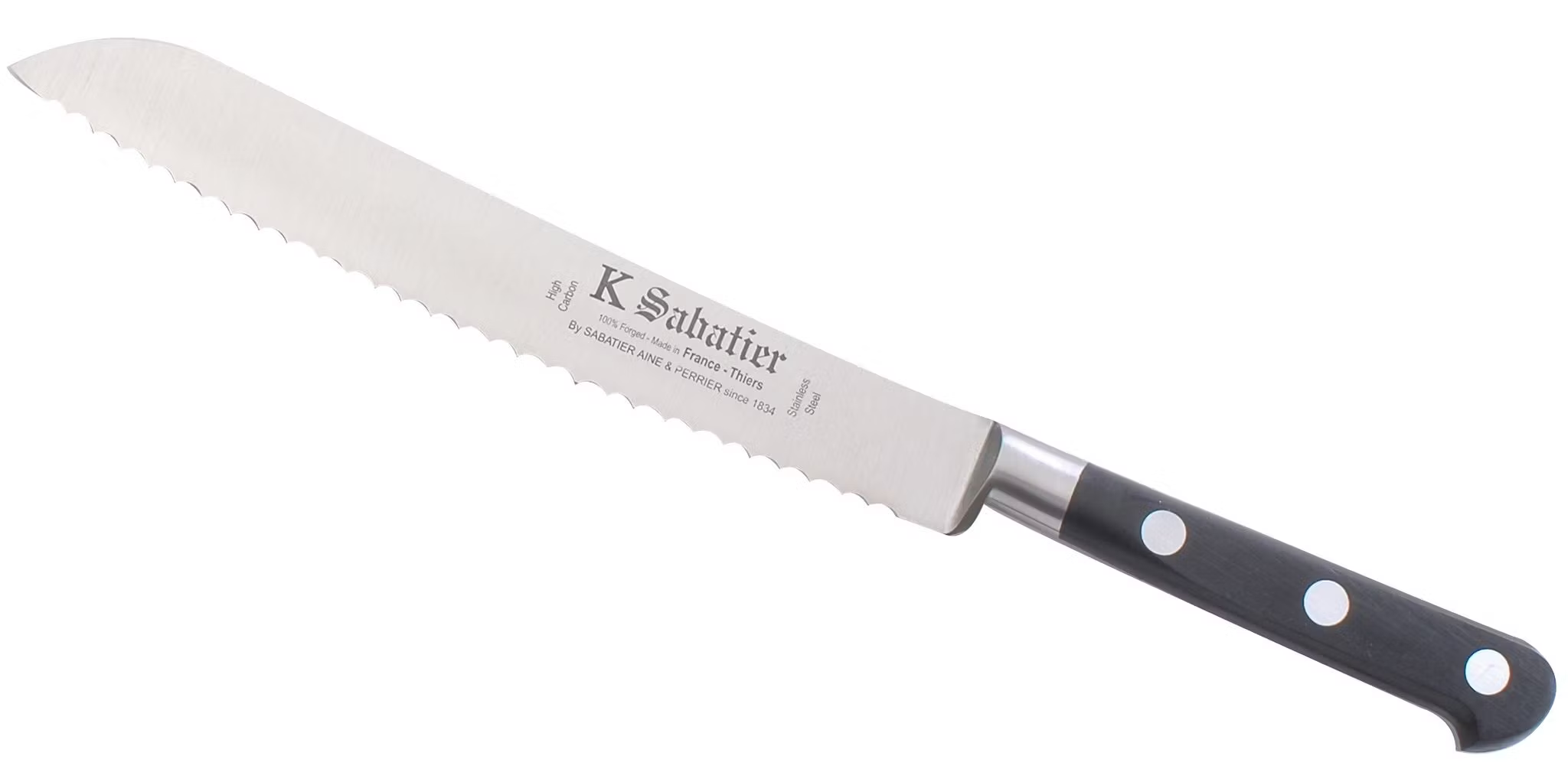
Sabatier K Bread Knife 20 cm is a hand-forged stainless steel bread knife from Thiers, its wavy serrated edge cutting through hard crust without squashing.
A freshly baked loaf deserves a knife that does not flatten it. The bread knife from Sabatier K has a 20 cm blade and is built with the same care as the range's chef's knives, which is no given for a bread knife.
The wavy serration runs along the whole edge. The teeth bite into a hard sourdough crust where a smooth edge would just slide, and then you saw through the bread with light strokes without pressing. The same principle works on anything with a hard or slippery outside and a soft inside: ripe tomatoes, croissants, sponge cake, pineapple and a bun to be shared.
A 20 cm blade is enough for loaves, baguettes and normal-sized sourdough breads, and the knife is easy to store. It is considerably sturdier than the thin, stamped bread knives many people have at home. Here the blade, round bolster and tang are forged in one piece, and that shows in how straight the knife travels through the bread.
The handle is black POM with three rivets, the same as on the rest of the range. The steel is around 55 HRC. On a serrated knife the tooth tips take most of the wear, so the edge rarely needs attention.
The knife comes from Sabatier Aîné & Perrier, the family company in Thiers behind K Sabatier. Sabatier is a name several manufacturers share, so look for the K when you want knives from this forge.
A good bread knife is one of the tools used most in a kitchen, both at home and at the bakery or restaurant serving counter. This one is craftsmanship we are proud to have in the range. It sits well alongside the Sabatier K Chef's Knife 20 cm and the Sabatier K Paring Knife 10 cm as a classic basic set of three knives.
Yes, but not in the same way as a smooth edge. Each wave is sharpened separately with a narrow, round sharpening rod. It is seldom needed, and you are welcome to get in touch if you want advice.
For ordinary loaves, baguettes and most homemade breads, yes. Very large round sourdough loaves may need turning once during cutting.
Tomatoes, citrus fruit, pineapple, melon and sponge cake bases. Anything where a hard surface needs to be broken without squashing the soft part underneath.
Your cart is empty, but doesn't have to be..